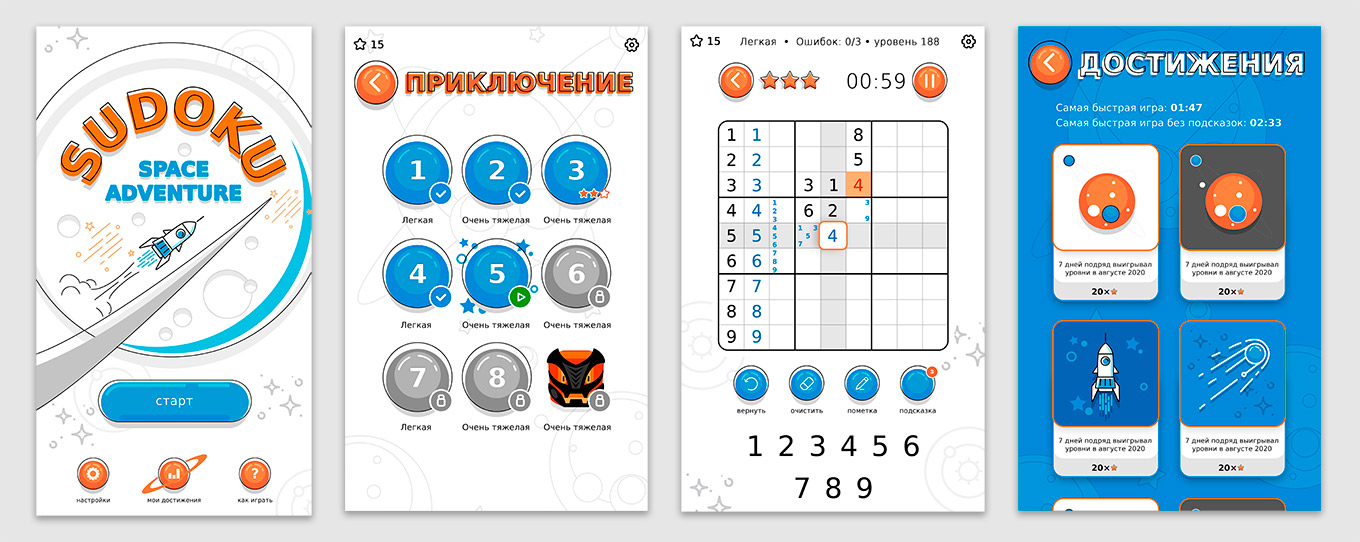
This is a mobile game in the genre of a puzzle, Sudoku subgenre that works according to classic sudoku rules. It has more than

ESK needed to walk the full mobile game cycle: prototyping, interfaces, design, Unity development, store publishing, and later updates that improve the product. Sudoku Space Adventure is a real store release, not a throwaway tutorial — classic sudoku rules in a space-themed casual puzzle.
We picked Unity because C# developers were already on staff, so production started without a long hiring ramp. The puzzle genre allows simple visuals alongside a heavy level generator, which keeps artists focused on UI assets while engineers own algorithms and tooling.
We studied competitors but skipped a large game loaded with daily contests — that would hurt early retention. Future changes were planned upfront; after publish the title entered ad-channel testing for CPI and LTV while keeping architecture ready for new modes.
Unity hosts the client: touch-friendly board input, hint and error feedback, and local save of campaign progress across many generated boards. Graphics stay lightweight so performance targets hold on budget Android hardware as well as recent iPhones.
The level generator produces solvable grids and buckets them by difficulty; content ships in batches validated before players see them. Ads integrate without blocking core puzzle flow — rewarded and interstitial placements follow the casual free-to-play pattern described in the brief.
Two months of focused work took the title from concept to published stores as an own ESK product. Ongoing updates can add retention features, but the first release prioritized a complete pipeline lesson for the studio and a playable sudoku product for users.

Sudoku Space Adventure is a published puzzle in the sudoku subgenre with classic rules and a large level count. Players get offline-friendly sessions; the studio gets a shipped store reference clients can try on Google Play and App Store.
The internal mission succeeded: the team practiced prototyping, Unity delivery, content generation, monetization hooks, store operations, and ad testing for CPI and LTV in one coherent project rather than scattered experiments.
Retention may trail live-ops-heavy titles until we add events and leaderboards — that was expected from the brief. The codebase and analytics foundation remain the launchpad for content updates, daily challenges, and stronger meta features driven by player feedback and store reviews.
Describe the task — we will name the timeline and price within an hour.